



IFCN brought together dairy researchers from around the world for its 27th Annual Dairy Conference. This year’s conference focused on the theme, “Building the Future of Dairy: Innovation & Sustainability in a Changing World.” Held online on June 10–11, 2026, the event welcomed more than 50 dairy researchers from across the globe to exchange insights and discuss the future of the dairy sector.
2025 A standout year for global milk supply
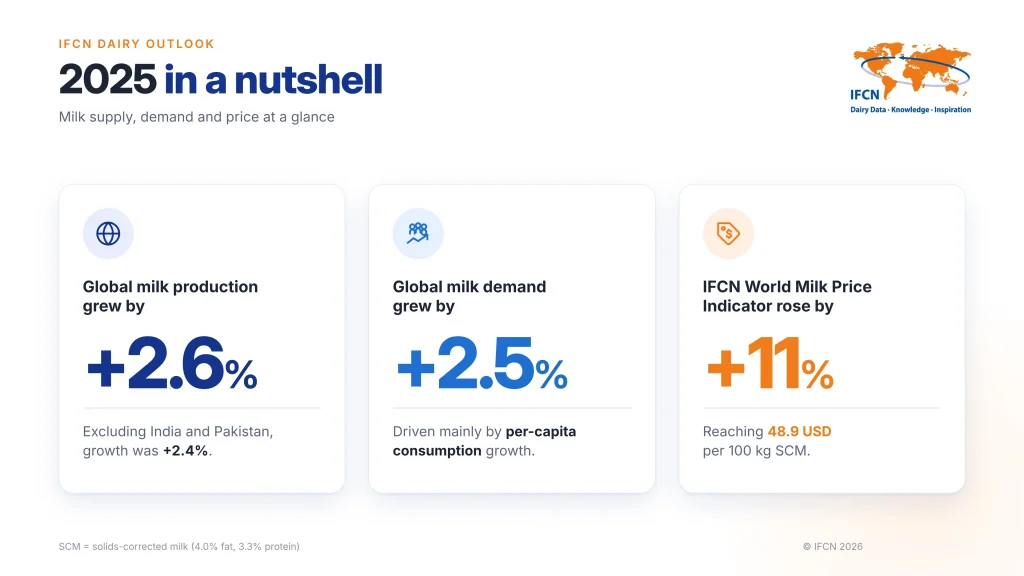
During the first day of the conference, the IFCN team outlined the key developments shaping the global dairy market in 2025. Global milk production expanded solidly, growing by 2.6% in 2025 surpassing the 1 billion tonne SCM mark, with broad-based contributions from regions including the EU, North America, and Latin America. At the same time, global demand increased, driven primarily by rising per capita consumption, reflecting shifting consumption patterns linked to income growth, urbanisation, and recovery in food service. This strengthening supply-demand balance was accompanied by higher price levels, with the IFCN World Milk Price Indicator rising significantly by 11% vs. 2024, underlining a market where value creation is becoming more important. However, behind this positive overall picture lies a more complex reality: supply growth was uneven across regions and gained momentum later in the year, while prices and margins varied depending on local market dynamics, feed costs, and production systems. Although 2025 can be considered a strong year for dairy globally, characterised by expanding supply, resilient demand, and improved prices, the underlying structural challenges, such as herd consolidation, regional imbalances, and evolving demand drivers, will play a critical role in determining whether this growth trajectory can be sustained in the years ahead. These insights, prepared and presented by the IFCN team, represent preliminary results.
During the breakout sessions, partners engaged in in-depth discussions around three key themes shaping regional dairy markets: milk production, milk prices, and dairy demand. Participants shared perspectives on the drivers behind production trends in 2025, highlighting factors such as farm economics, feed conditions, weather, and structural constraints, while also debating whether future growth strategies will prioritise volume expansion or higher milk components like fat and protein. On milk prices, the discussions reflected a mixed picture, with some regions experiencing strong price signals supported by global market dynamics, while others faced weaker transmission at farm level; looking ahead, participants noted that volatility may persist into 2026, driven by supply fluctuations, input costs, and evolving demand patterns. Finally, on the demand side, partners described a landscape where growth is increasingly shaped by changing consumption habits, income developments, and market maturity, with some regions seeing continued expansion while others face signs of saturation or shifting preferences. Overall, the exchanges underscored both the diversity of regional realities and the shared challenges and opportunities that will define the dairy sector over the coming decade.
During the panel discussion “Global Dairy Markets”, international experts shared insights on milk supply, demand, and price developments in their respective countries. In 2025, approximately 25–30% of New Zealand dairy farmers were using virtual fencing collars, which provide greater grazing flexibility and help improve pasture management. Beef prices increased significantly and are expected to remain strong throughout 2026. Fonterra has also adjusted its strategy, placing greater emphasis on commodity products. As a major dairy exporter, New Zealand’s milk prices largely determine future revenue streams for farmers. While higher milk prices typically encourage increased production, the supply response is now more limited than in the past. Farmers are increasingly focused on improving efficiency and productivity rather than simply expanding output. Poland increased milk production by around 3% compared with 2024. A key factor behind this growth has been the resilience of Polish dairy farmers, who have invested heavily in technology, machinery, and farm infrastructure. Despite lower milk prices towards the end of the year, production continued to rise, supported by relatively low input costs. Milk quality remains a major priority, as many processors reward farmers for producing higher-quality milk. Premium payments for superior milk quality have encouraged continued investments and improvements at farm level. South Africa continues to face challenges related to Foot-and-Mouth Disease (FMD), with outbreaks affecting the sector in both 2025 and 2026. However, the dairy industry has made significant progress by successfully vaccinating dairy herds and securing sufficient vaccine supplies for a second round of vaccinations. South Africa has a highly market-oriented agricultural sector and operates within a relatively open economy. As a result, dairy producers are strongly influenced by developments in global commodity markets. Although import tariffs are in place, they provide limited protection, leaving the sector highly exposed to international price movements and market conditions.
Favorable economic conditions supported positive profits and improved farm performance in 2025
During the breakout sessions, partners engaged in in-depth discussions around three key themes shaping dairy farm competitiveness: efficiency, investments, and costs. Across countries, improving efficiency was widely seen as the main pathway to enhancing profitability and resilience. Feed efficiency and feed management remain the key drivers of farm performance, while technology and automation increasingly support productivity gains and labour efficiency. Participants also highlighted opportunities in genetics, reproduction, and precision farming technologies. Discussions on investments emphasized the need to balance short-term efficiency gains with long-term competitiveness. Current priorities include feeding systems, forage equipment, automation, animal welfare, and environmental management. Looking ahead, investments are expected to focus increasingly on advanced technologies, data management, sensors, robotics, and infrastructure development.
Regarding costs, feed remains the largest expense for dairy farms in most countries, followed by labour, energy, and compliance costs. Rising wages, labour shortages, and stricter regulatory requirements are expected to continue putting pressure on farm profitability. As a result, many farmers are expected to further adopt automation and digital technologies to improve efficiency and reduce reliance on labour.
During the panel discussion “Farm Economics and Volatility”, international experts shared insights into the key characteristics of typical dairy farms in their countries, the main cost drivers over the past 3–5 years, and the biggest economic opportunities for dairy farmers over the next five years. In Estonia, the dairy sector consists of a mix of small family farms and large, highly efficient commercial operations. About 50% of farms are small (1–100 cows), while the remaining cows are increasingly concentrated in larger farms with 60–300 cows, indicating ongoing structural consolidation. In the United Kingdom, dairy systems are highly diverse, ranging from seasonal spring-calving grazing systems similar to New Zealand models to large fully housed units with more than 3,000 cows. This diversity, combined with weather variability, creates ongoing challenges in managing volatility. Mexico shows strong regional differences. In La Laguna, which produces around 25% of the country’s milk, large corporate farms and vertically integrated operations dominate, with herd sizes reaching up to 20,000 cows. Central Mexico is characterized by specialized farms ranging from 50 to 5,000 cows, while the southern regions are dominated by small family farms with fewer than 20 cows. Regarding cost drivers, Estonia is primarily affected by feed and energy costs, including electricity and diesel, as well as geopolitical pressures. Labour costs are also rising, alongside increased investment needs linked to climate change and animal welfare requirements, such as improved housing and ventilation systems. In the United Kingdom, fuel and labour costs are the main pressures, while feed prices have remained relatively stable compared to five years ago. Although milk prices were strong over the past three years, recent declines since October have tightened cash flows and reduced margins. In Mexico, feed remains the dominant cost driver and is expected to stay the largest expense. In the UK, an oversupply of milk has added further pressure on margins, although there is hope for market rebalancing in the autumn. Overall, profitability is currently under strain in many regions. Despite these challenges, investment activity varies by region. In Estonia, better-managed farms have remained profitable in recent years and are continuing to invest, including herd expansion, with a strong focus on efficiency as a key growth driver. In Mexico, large farms continue to expand, while medium and small farms tend to maintain production levels. Consolidation is expected to accelerate if milk prices decline further.
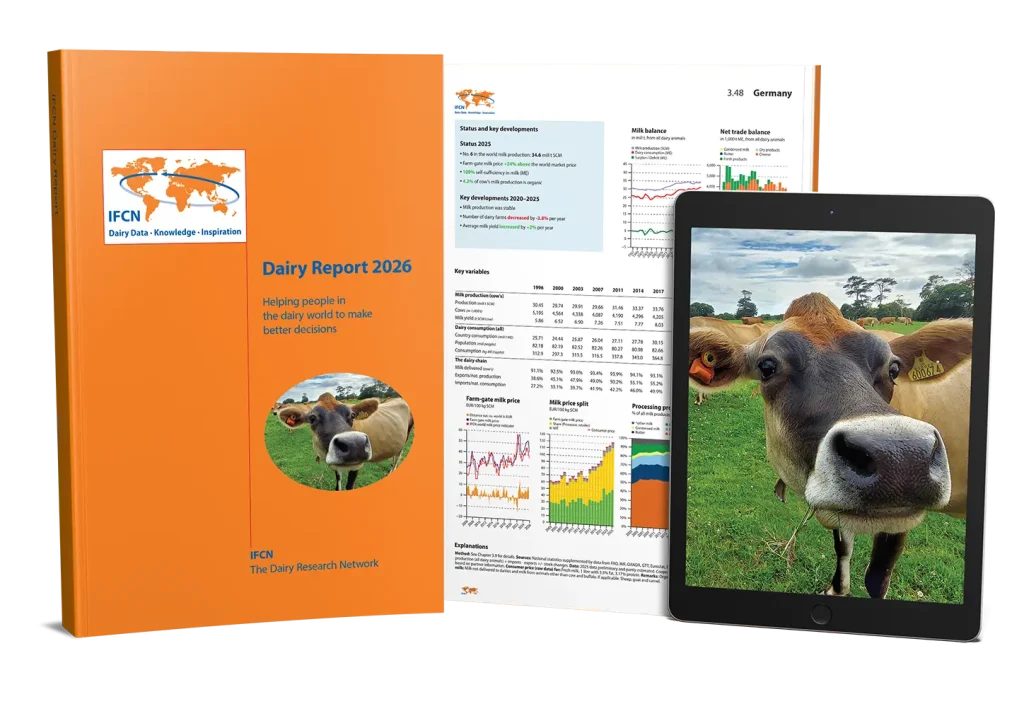
NEW IFCN Dairy Report 2026
Get your personal copy NOW!
A comprehensive overview of the complex dairy world in a 224-page book based on IFCN research.