



Global milk production grew by 2.6% and dairy demand by 2.5% in 2025, according to the IFCN Dairy Report 2026. The annual Dairy Report from the IFCN Dairy Research Network analyses key dairy indicators for 125 countries – from milk supply and consumption to world dairy trade, farm economics and the IFCN World Milk Price.
OUT NOW
The new IFCN Dairy Report 2026 is available
The 224-page IFCN Dairy Report 2026 brings together the latest data on global milk production, dairy demand, world dairy trade, farm economics and milk prices for 125 countries – the key reference for strategic decisions in the dairy world.
Key Insights from the IFCN Dairy Report 2026
Milk production: global milk production grew by 2.6% year on year in 2025. Mature dairy regions showed stable or renewed growth and Latin America expanded strongly, while China and the Near and Middle East remained largely stagnant.
Dairy demand: demand for dairy products recovered by 2.5% in 2025, driven by 0.8% population growth and a 1.7% increase in per capita consumption.
World dairy trade: trade strengthened as mature exporting regions expanded supply and import demand from emerging markets grew, while China’s imports recovered after several years of decline.
Farm profitability and milk price: margins were good in early 2025 thanks to high milk prices and lower feed costs, but tightened towards the end of the year. The IFCN World Milk Price rose by 9.5% to an average of 48.4 USD/100 kg milk (SCM).
Dairy World in a Nutshell: Key Figures for 2025
| Dairy world in a nutshell | Unit | 2025 | Change 2025 vs. 2024 |
|---|---|---|---|
| Milk supply | |||
| All milk production | mill. t solid corrected milk (SCM) | 1,027 | +2.6% |
| Farm number | mill. | 109 | −0.3% |
| Average farm size | head/farm | 3.4 | +0.6% |
| Average milk yield | t milk/animal/year | 2.6 | +2.4% |
| Production per farm | t/farm | 9.4 | +3.0% |
| Milk consumption | |||
| All milk consumption | mill. t milk equivalents (ME) | 1,025 | +2.5% |
| Consumption per capita | kg ME per capita | 126 | +1.7% |
| Population | billion | 8.14 | +0.8% |
| Price | |||
| IFCN World Milk Price Indicator | USD/100 kg SCM | 48.4 | +9.5% |
All milk production includes milk from cows, buffaloes, camels, goats and sheep. SCM = solid corrected milk (standardised to 4.0% fat and 3.3% protein). ME = milk equivalents (fat and protein method). Milk yield is based on cow and buffalo milk and animals; farm numbers represent dairy cow and buffalo farms. Source: IFCN Database, status of data: September 2026.
Global Milk Supply Growth Strengthened in 2025
IFCN monitors global milk production on an annual and monthly basis, including real-time estimates. This provides one of the fastest market updates available, which is crucial for understanding milk price development.
According to the Dairy Report, global milk production rose by 2.6% in 2025 to 1,027 million tonnes of solid corrected milk (SCM) (Fig. 1). This was a clear improvement on the weak growth of 2022 (+1.2%), but still below the 2017–2021 average of +2.9%. For the headline figures presented at the IFCN Conference 2026, see our news article Global milk production up 2.6% in 2025.
In 2025, the EU-27 regained momentum and North America remained a stable contributor to global milk supply growth. Latin America recorded its strongest growth in a decade, supported by healthy producer margins and favourable weather. Favourable conditions and strong milk prices also boosted production in New Zealand. China recovered modestly, but its contribution continued to decline, while the Near and Middle East recorded no production growth.
Global Dairy Demand: Per Capita Consumption Keeps Rising
Global dairy demand continued to recover in 2025, increasing by 2.5% year on year to 1,025 million tonnes of milk equivalents. Per capita consumption has been rising for two decades and reached 126 kg milk equivalents in 2025.
Growth was supported by rising per capita consumption, population growth, stronger milk supply and lower domestic prices. Demand increased particularly strongly in Latin America, and India also recorded solid growth. In contrast, demand declined in Ukraine due to war-related demographic changes, market imbalances and weak purchasing power.
World Dairy Trade Expands amid Strong Demand and Rising Uncertainty
Global dairy trade expanded in 2025, supported by favourable production conditions and strong import demand. North America recorded the strongest export growth, while demand from South Asia, Africa and the Near and Middle East, together with a recovery in Chinese imports, helped absorb the additional supply and support global dairy prices. However, trade policies, exchange rates, geopolitical tensions and climate-related events remain important sources of market uncertainty.
Milk Price Development in 2025
The IFCN World Milk Price indicator increased by 9.5% in 2025 to 48.4 USD/100 kg SCM (Fig. 2). In the first half of the year, the milk price was supported by tighter supply in the fat market and strong butter prices. It turned down in the second half, when milk supply rose strongly among major producers in the US, Europe, Latin America and Oceania.
Dairy Market Outlook 2026
In the first half of 2026, milk prices recovered after declining for seven months from 52 to 43 USD/100 kg SCM. Despite continued strong milk supply, improving demand for protein commodities supported the market, helping the milk price return to around 52 USD/100 kg SCM by May 2026. Since then, prices have eased again to around 46–48 USD/100 kg SCM.
However, rising feed, energy and fertiliser costs, combined with geopolitical volatility, put renewed pressure on farm margins. Dairy economics became particularly unfavourable in the USA, although margins including cattle returns remain at a higher level. In several other countries, margins moved back towards their long-term average, making further production growth less attractive.
At the time of writing, global milk supply is still growing in 2026, but momentum is slowing as economics weaken and weather-related risks increase. The protein market and an anticipated tighter supply are setting a floor for the milk price, while current supply and accumulated stocks, especially of butter, are capping it. The milk price is therefore expected to continue fluctuating around these levels of 46–48 USD/100 kg SCM.
About the IFCN Dairy Report 2026
The IFCN Dairy Report has become a reference publication for researchers and companies across the dairy chain and has been published annually since 2000. Its analysis and comprehensive data provide the background for strategic decisions and help people in the dairy world make better decisions.
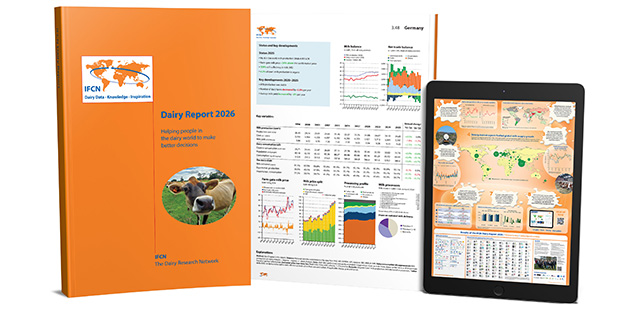
The Dairy Report 2026 standardises dairy data worldwide and includes:
- Farm comparison and farm economics
- Sustainability of dairy farms
- Monitoring of global dairy economic indicators
- Status, trends and drivers of milk production
- Maps
- 125 country pages
IFCN Dairy Sector Data cover 126 countries (125 plus the EU), representing 99% of world milk production. The IFCN Farm Analysis covers 55 countries with 179 typical farms in 67 dairy regions, representing 90% of world milk production.
Interested in the IFCN Dairy Report 2026? Contact us at info@ifcndairy.org or visit dairyreport.online.
About IFCN
IFCN is a global network for dairy economic research and consultancy. In 2026, researchers from more than 100 countries and more than 120 agribusiness companies are members of the network. For over 20 years, IFCN has created a better understanding of the dairy world, serving its members with annual conferences, tools and data.
IFCN offers researchers global networking through the annual IFCN Dairy Conference – most recently the IFCN Conference 2026 in Parma – as well as capacity building in dairy economic analysis at farm and sector level, and IFCN tools and data to share knowledge with dairy stakeholders.
For companies, IFCN offers three partnership packages:
- Basic: a holistic picture of the global dairy world, networking with peers and companies, and learning and capacity building
- Premium and Ultimate: world-class dairy business intelligence, comparable, global and real-time data, and better decisions based on full access
In today’s fast-changing and complex dairy world, business intelligence is vital for your organisation’s success. IFCN’s mission is to help you make better decisions with dairy data, knowledge and inspiration.
Feedback welcome: the IFCN Dairy Situation Analysis is an ongoing research project, and IFCN appreciates any feedback to further improve the work. The IFCN Dairy Report is published annually in October. For comments or questions, please contact us.